


Together we are making a difference
Wildfires, floods, and toxic waste spills dominated the headlines and the lives of people from coast to coast this year. These events highlighted that our work, and yours, is more important than ever.
THROUGH A HARROWING YEAR, WE MADE MEANINGFUL CHANGE
This past year was a challenging one across the country. We faced wildfires, floods, threats to our forests and farmlands, plastic pollution, toxic spills and more. That’s why we must work every day to create change. Real change. And this year, we did exactly that.
With your generous support, we took steps towards a future where everyone in Canada can live and thrive in a healthy environment – protected for generations to come. We demanded climate action, fought for the Greenbelt and said goodbye to several dangerous single-use plastics. And we couldn’t have done it without you.
Here’s a look back at what we accomplished this past year.
OUR WORK


OUR IMPACT










Ending Climate Change
It has never been more clear that we need urgent action to tackle climate change. This means reducing fossil fuel pollution, stopping new oil and gas extraction projects and transitioning off of fossil fuels, including ending their use to generate electricity.
Thanks to our ongoing advocacy and the actions of our supporters, we generated some important victories. First, the federal government announced an end to financing international fossil fuel projects. Then Canada joined other countries to call for a phase out of fossil fuel production. Both these actions are important steps in leading to a cleaner and safer future. But there is a lot more to do.
One important step is an oil and gas emissions cap. As Canada’s largest and fastest-growing source of pollution, oil and gas companies must be forced to do their fair share to meet Canada’s climate goals. We delivered a petition signed by over 80,000 people in Canada asking for a strong and ambitious cap on oil and gas emissions, and the government responded by confirming its commitment that an emissions cap regulation will come.
We also went to the supreme court to defend the Impact Assessment Act, an important environmental law that requires environmental assessments to consider the climate impacts of new projects such as mines, fossil fuel extraction and pipelines. This law was under attack by Alberta.
We also launched our Federal Oil & Gas Lobbying Bot this year as a way to take publicly-available information out of a complicated government website and make it more accessible. The bot’s twitter posts have drawn attention to the incessant lobbying efforts of the oil and gas industry.
As the province of Ontario continued to push for new and expanded fossil gas power plants, we worked with community groups and businesses to push back against gas plant developments at a local level and ran an awareness campaign highlighting how bad “natural” gas is for you, your health and the environment.
In Alberta, trillions of litres of toxic tailings waste from oil production are perched on the shores of the Athabasca River, threatening water, wildlife and Indigenous communities. We launched a report mapping decades of destruction caused by these sprawling tailings, educated the public about our alarming findings, and the ongoing environmental racism in the oil sands.
We further highlighted the threat of these toxic tailings on the international stage alongside Indigenous Nations and allies during the COP15 United Nations Biodiversity Conference.
Building the Clean Economy
In order to move Canada towards a clean economic future, we need policies that ensure workers and communities are supported, financial institutions align their investment practices with our climate goals and cleaner vehicles are put on the road backed by robust public transit systems.
Despite voluntary commitments to green their business practices, Canadian banks continue to put money into polluting investments such as oil and gas. To address this, Environmental Defence in partnership with EcoJustice and Shift: Action for Pension Wealth and Planet Health published a comprehensive guide: Roadmap to a Sustainable Financial System in Canada. The report lays out pathways for how the government can regulate our financial system to create a resilient and climate safe economy.
Additionally, we worked closely with Independent Senator, Rosa Galvez, to develop and (along with 89 academics, stakeholders and investors) endorse the benchmark private Senate Bill, the Climate Aligned Finance Act (CAFA).
We worked with the federal government to ensure it fulfilled its promise to table a Just Transition legislation. Although the government did not officially table the act, they did take a step in the right direction, tabling an interim framework.
To help MPs understand public demand , we mobilized supporters to send over 5,000 letters to federal government decision makers and MPs across Canada calling for a just transition so workers and communities are not left behind in the transition to a green economy.
Our efforts to move Canada towards a clean transportation future included a report in partnership with Equiterre that exposed the duplicity of car companies that claim to be all-in on electric vehicles, while lobbying behind closed doors against regulations that would make them sell more zero-emission vehicles
Meanwhile, Canada’s first draft of Zero Emissions Vehicle Sales Regulation – a Clean Car Standard reflected our research and advocacy efforts by including a cap on overall zero-emission vehicle credits allowed to go to plug-in hybrid vehicles, and the ruling out of ‘super credits’.
Kicking Out Toxic Chemicals
People in Canada are exposed to thousands of chemicals every day, including bisphenols, phthalates, and PFAS. These substances are linked to cancer, reproductive harms and other serious health effects.
To tackle toxics, we are pushing for the development of a stronger framework and tools to better protect people and the environment from pollution and toxic chemicals, particularly vulnerable populations.
Our efforts include advocating for several key amendments to Bill S-5, which proposes long overdue updates to modernize the Canadian Environmental Protection Act (CEPA), Canada’s cornerstone toxics legislation. Key provisions in the bill include stronger control of toxic substances, assessing the cumulative impacts of toxics and their effects on vulnerable populations, and introducing the right to a healthy environment, for the first time under federal law.
Additionally, we released a report: Passing the Buck: the toxic cost of dollar store products in Canada, highlighting the persistent failure of Canada’s regulatory system in adequately protecting the public’s health, especially populations disproportionately affected by toxics. The report underscores the urgent need for increased transparency, retailer accountability, and stronger laws on hazardous substances.
We celebrated the passage of Bill C-226, the National Strategy on Environmental Racism and Environmental Justice Act, in the House of Commons. Once approved and passed into law, this bill would require the government to develop Canada’s first national strategy on environmental racism and environmental justice.
Finally, we called on the federal government to support pesticides reduction at COP15 UN Biodiversity Conference, and welcomed the Kunming-Montreal Global Biodiversity Agreement. We also took Health Canada to court over glyphosate product renewal and will continue to advocate for strong legislation to drastically reduce high-hazard pesticides and their harms.
Safeguarding Canada’s Freshwater
The Great Lakes provide drinking water for millions of people, and support billion-dollar economies. These essential bodies of water are facing a multitude of problems, including threats from pipelines and oil spills, nutrient pollution and toxic algae blooms.
One of the largest threats to the Great Lakes is the Line 5 pipeline. This ecological disaster in the making crosses through the heart of the Great Lakes basin, and a rupture could be devastating.
This year, we continued to raise awareness about the risks of Line 5, including holding a press briefing and panel with an international coalition of Indigenous Nations and environmental experts at the COP15 UN Biodiversity Conference.
We also welcomed the historic Great Lakes funding of $420 million dollars over ten years from the federal government. This announcement follows years of our advocacy for increased Great Lakes funding, including writing several letters to the government and working alongside the Canadian Coalition for Healthy Waters on freshwater funding advocacy.
Over the summer, we also continued our annual #WeAreLakeErie Day, and asked supporters to share their personal stories and photos of Lake Erie on social media with the hashtag #WeAreLakeErie. This online event helped to demonstrate that Lake Erie is immeasurably special and deserving of better protection from toxic algae blooms and other threats.
Ending Plastic Pollution
The problem with plastic goes beyond litter and landfills. Plastic pollution affects everything from air quality, to climate change to human health. Some of this pollution is hard to see with the naked eye, but it’s all part of the destructive cycle of plastic. This year, we continued the fight to hold industry and government accountable for the plastic pollution crisis.
As part of our #PlasticFreeJuly campaign, we called on our supporters to join forces and demand that the federal government #ExpandTheBan on single-use plastics. Together, we sent over a thousand tweets to the government and reached almost 4 million Twitter users with our message. We had such a big impact that our hashtag was the number 9 trending topic in Canada by noon.
We also pushed the federal government to take a critical step toward beating plastic pollution by introducing rules around what can be labelled as recyclable or compostable. We were glad to see this move towards preventing greenwashing and ensuring people in Canada have clear and honest labels.
Finally, we saw one of our biggest wins to date come to fruition: the single-use plastic bans we worked so hard together to achieve came into effect. Checkout bags, stir sticks, straws, cutlery and certain takeout containers can no longer be made or imported for sale in Canada. These harmful and unnecessary products have long plagued Canadian shorelines, landfills and city streets, but soon they’ll be a thing of the past. And you helped make it happen!
Ontario Yours to Protect
Over the past year, the provincial government brought a whirlwind onslaught of legal, regulatory and policy attacks on Ontario’s Greenbelt, farms, forests and wetlands.
We have helped raise awareness about the threats to the Greenbelt by ensuring the media was covering this important issue, working with other aligned organizations and blanketing the province with “Hands Off The Greenbelt” signs.
Since last fall, Ontario has seen a major outpouring of public opposition to the Greenbelt removals, leading to the province’s largest environmental movement of all time. There have been hundreds of rallies across Southern Ontario – and more are popping up every month!
Our work has generated another significant win for the Greenbelt:
The largest area removed from the Greenbelt by Premier Ford is located in the Duffins Rouge Agricultural Preserve (DRAP). The DRAP is 4,700 acres of mainly class 1 farmland interwoven with rare habitat. Not only does the DRAP protect some of the most valuable agricultural land in all of Canada – it supports the ecological integrity of the adjacent Rouge National Urban Park (RNUP).
After Canada’s Minister of Environment and Climate Change received 1000s of letters from Greenbelt supporters, he announced a study to examine the effects of development projects adjacent to Rouge National Urban Park.
YOU
We wouldn’t exist without you. You signed petitions, attended our events, wrote and called the government and financially supported our programs.
Everything we do is made possible because of your generosity, enthusiasm, passion, and dedication. You inspire us to continue to build a better future by fighting the climate crisis, stopping plastic pollution, eliminating toxic chemicals, saving our forests, farms and wetlands and protecting our freshwater.


OUR PEOPLE
ENVIRONMENTAL DEFENCE is a team of passionate, creative, and talented people devoted to making positive change happen. Our staff and volunteer board work hard every day to protect Canada’s environment and human health. But we don’t do it alone. We also have an expert advisory committee that offers ideas, advice, and feedback to help us guide our programs.
Financials
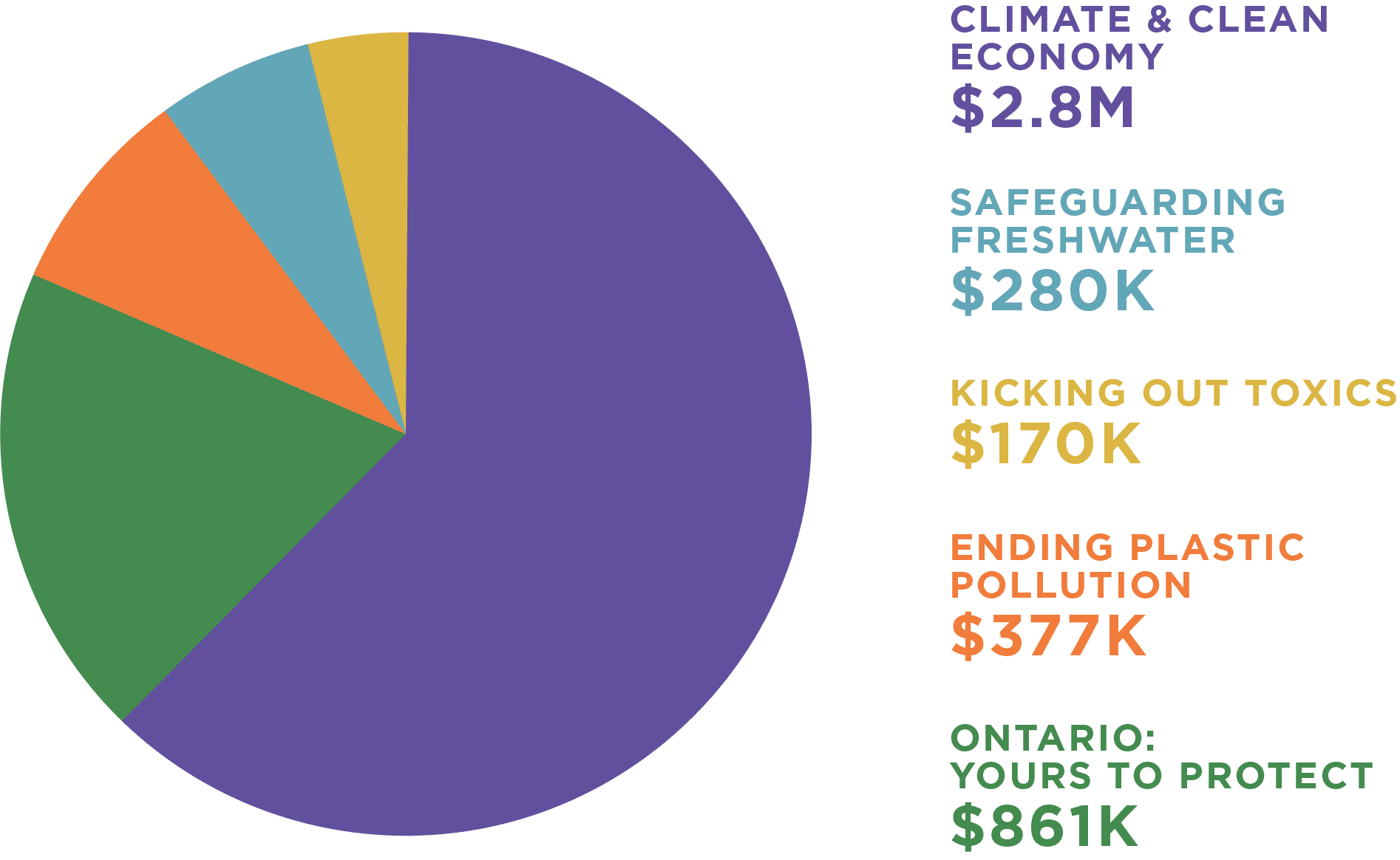
It takes all of our dedicated team working together to deliver the outcomes we’ve shared in this report. The program, engagement and communications staff along with our finance, development, and administration teams come together and deliver the change we have committed to our funders and supporters. For the full audited financial report, click here.
THANK YOU
A BIG THANKS to all of the individuals and organizations who generously supported our efforts between April 1, 2022 and March 31, 2023. Together, we accomplished more than we thought possible, and with your continued support, we know that we can accomplish even more in the year to come.