


Together we are making a difference
This past year was dominated by environmental bad news – from record breaking heat waves and fires to droughts and floods – all highlighting the critical work needed to address the climate and biodiversity crises and Environmental Defence’s role in finding solutions. We did this by offering practical policy advice, holding governments and corporations accountable, and working alongside people and communities to protect our planet.
As you’ll see below, our work resulted in key victories such as stopping sprawl from paving over precious farms and wetlands, ending new thermal coal mines, getting retailers to remove toxic chemicals from food packaging, making fossil fuel subsidies a major federal election issue, and banning the production and export of several single-use plastic items. We also made progress on stopping an unnecessary mega-highway, modernizing our environmental protection laws, and pushing for the expedited passage of Canada’s first environmental racism bill.
Relatedly, we put a renewed focus on the ways in which marginalized communities are disproportionately impacted by the effects of climate change, and environmental degradation, and the work that needs to be done to address these inequalities. As a result, we are making our programs more inclusive to better serve the needs of our communities so that no one is left behind.
Together, we made progress and thanks to your support we will continue to defend our environment and human health.
OUR WORK


OUR IMPACT








Climate & Clean Economy
Fires, floods, crop failures, habitat loss – the impacts of the climate crisis are now weekly headlines, across the globe and in Canada.
We know that the best way to address this crisis and the harms caused by fossil fuel pollution – in fact the only way – is by working in community. This year, we focused on strengthening and expanding our relationships. In March, we co-hosted the Dialogues for a Transition to a Just Economy, which brought together labour, environmental organizations, and Indigenous organizations and First Nations. And throughout the year, we re-doubled our efforts to build trusted relationships with communities harmed by the ever-growing tailings “ponds”, which are actually toxic lakes filled with chemicals from tar sands production.
Our work generated significant victories. Most notably, we helped secure a commitment from the federal government to end thermal coal exports and new mines – a giant step towards a fossil-free future. Our federal election campaign helped keep oil and gas subsidies in the spotlight, with a helpful guide for voters and a list of questions to ask candidates. And finally, although the federal government did go ahead with a new, wasteful subsidy for unnecessary carbon capture technology, we did block it from applying to a process that would increase oil and gas production at a time when phase out is necessary.
Big Oil is not the only industry holding Canada back from meeting our climate objectives, transportation accounts for Canada’s second largest source of greenhouse gas emissions. Highlighting this pressing issue, the launch of our Car Wars report marked a strong starting point for the future work we will be doing to tackle transportation emissions and an auto industry preference for selling massive, gas guzzling vehicles.
In the year ahead, we will advocate for climate policies and regulation that ensures Canada has a prosperous green future, where all communities can thrive.
Kicking Out Toxic Chemicals
Every day, Canadians are exposed to thousands of toxic chemicals in the products they buy. These chemical exposures are linked to cancer and serious reproductive, behavioural and developmental health impacts. Without strong toxics laws, the burden of this toxic load falls disproportionately on low-income and racialized communities who can’t buy their way out of these exposures. We’re working hard to increase transparency in labelling regulations, and get rid of toxic chemicals such as bisphenols, phthalates, and PFAS in consumer products so that everyone is safe from exposure.
After years of campaigning for stronger toxics laws, Bill S-5 was introduced to update the Canadian Environmental Protection Act (CEPA), Canada’s cornerstone environmental law. Strengthening CEPA will better protect human health and the environment from hazardous substances. Key amendments include assessing the cumulative impacts of chemicals on vulnerable populations and recognizing the human right to a healthy environment.
Following a multi-year campaign to phase out PFAS, Toronto-based Restaurant Brands International (RBI) which owns Burger King, Popeyes, and Tim Hortons announced it will ban toxic PFAS “forever chemicals” in food packaging globally by 2025.
Environmental justice shapes and informs our toxics work, and we have been calling for a national strategy to address the harms caused by environmental racism. Our efforts in advocating for action on environmental racism were successful over this past year as Bill C-226, Canada’s first environmental racism bill is one step closer to becoming law.
Safeguarding Canada’s Freshwater
The Great Lakes hold 84% of North America’s freshwater. But these once pristine sources of water, food, transportation and wonder are struggling. The Great Lakes are facing a multitude of threats—including toxic algae blooms, climate change, pipelines and plastic pollution. We’re continuing to work hard to protect these important water bodies.
One of the biggest threats facing the Great Lakes today is Enbridge’s deteriorating and dangerous Line 5 oil and gas pipeline, which runs right through the heart of the Great Lakes. In February, we published a report by an energy industry expert that revealed the truth Enbridge has been trying to hide—we do not need the Line 5 oil pipeline to meet our energy needs, and we can and must prioritize the protection of the Great Lakes.
The 9th Canada-Ontario Great Lakes Agreement was also published this year and we were glad to see it included several of our recommendations. New Annexes have been written to address cleaning up chlorides, plastics and other harmful pollutants from the Great Lakes. It also included commitments for developing phosphorus management plans for Lake Erie which will help to address nutrient pollution and algae blooms.
This year, we also continued our work to raise awareness about the over application of road salt on sidewalks and streets which threaten drinking water and freshwater aquatic life.
Ending Plastic Pollution
Plastic causes harmful pollution at every stage of it’s lifecycle—from the toxic emissions and greenhouse gasses emitted during manufacturing all the way to when it ends up in landfills, incinerators or our lakes, rivers and communities. Plastic pollution impacts us all, but it causes disproportionate harm to those living next to production and disposal facilities, often low-income and Black, Indigenous and People of Colour communities. This year, we kept the pressure up on the government and industry to do more to protect people living in Canada from plastic pollution.
As part of our #PlasticFreeJuly campaign, we asked our supporters to help us call out Big Plastic for their appalling lawsuit aimed at trying to stop the federal government from addressing plastic pollution. And together, we had a big impact! Over 1,500 people took to Twitter to call out Big Plastic and their #TrashyTactics. We even became a trending topic in Canada.
We also led the effort with over 50 organizations to call on the government to take ambitious actions to reach their goal of zero plastic waste by 2030. We were glad to see the Minister of Environment and Climate Change acknowledge our call to action and express his gratitude for our efforts.
But our biggest win of the year was when the federal government released the finalized bans for six single-use plastic items—bags, straws, cutlery, takeout containers, stir sticks, and six-pack rings—which we were glad to see had been strengthened to include our recommendation for a ban on exports. This is a huge win that we’ve been working towards for many years. This is only happening because so many of us demanded it! We are excited about this first step in the right direction, but there is still so much work to be done.
Ontario Yours to Protect
Over the past year, Ontario’s environment was threatened by sprawl development on farmland, wetlands and other natural areas, by proposed mega-highways such as the destructive Highway 413, and by the Ontario government’s lack of action on climate change.
By working with other aligned organizations, and through the efforts of our supporters, we achieved some important successes during the year.
On May 3, 2021, the federal government approved our request that Highway 413 receive a Federal Impact Assessment. The Minister of Environment and Climate Change noted the negative impact the highway would have on federally listed endangered species, the increase in greenhouse gas emissions, and the public and Indigenous opposition to the highway. We are now waiting for the next step in the assessment process.
We have helped raise awareness about the Ontario government’s misuse of Minister’s Zoning Orders (MZO) to approve development on protected and at-risk lands. One MZO would have allowed a warehouse to be built on the provincially significant Lower Duffins Creek Wetland. Thanks to our efforts, and the work of local organizations and Indigenous Nations, there was a strong public outcry that led Amazon to withdraw its proposal for the warehouse and the Ontario government cancelled the MZO. The Lower Duffins Creek Wetland was saved!
Low-density sprawl on farmland is one of the biggest threats to Ontario’s environmental future. While the Ontario government pressured municipalities and regions to build more sprawl and expand their urban boundaries, communities fought back. In Hamilton, grassroots opposition, with support from our experts, led the city to choose to direct future growth to existing neighborhoods, saving thousands of acres of prime farmland!
YOU
We wouldn’t exist without you. You signed petitions, donated your birthday presents, attended our events, wrote and called the government and financially supported our programs.
Everything we do is made possible because of your generosity, enthusiasm, passion, and dedication. You inspire us to continue our work to improve the health of Canadians and our environment.
An Evening of Inspiring Change

On April 24, 2021, Environmental Defence hosted a virtual fundraising concert: Protecting Ontario’s Environment | A Virtual Benefit Concert with Sultans of String.
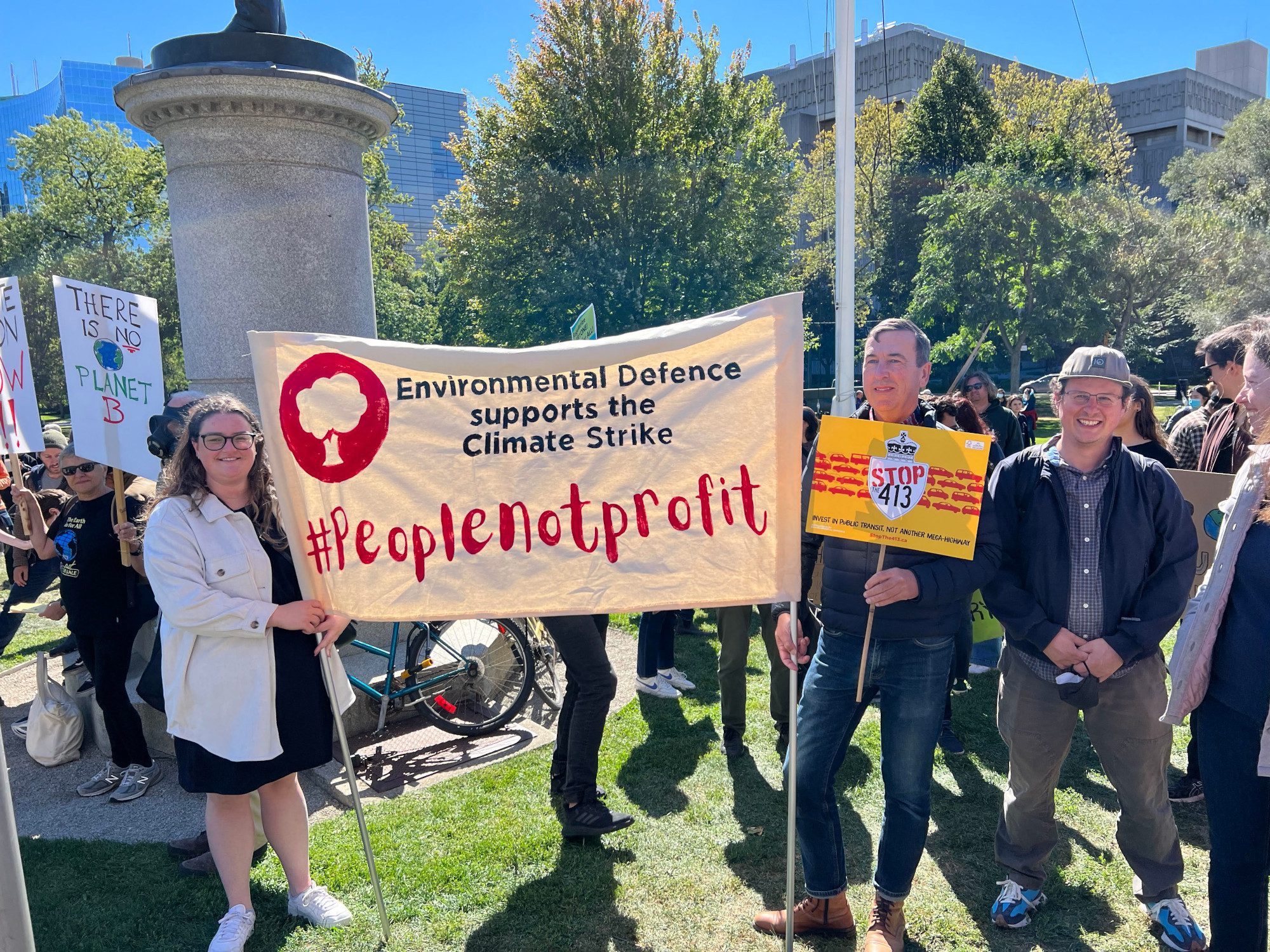
We were thrilled when Chris McKhool approached us about holding a virtual concert with his 3x JUNO nominee band Sultans of String. In addition to raising critical funds, the concert increased awareness of the systemic erosion of environmental protections in Ontario, and highlighted our campaign to Stop the 413, a proposed mega-highway that would pave over parts of the Greenbelt.
Our over 400 attendees were treated to a fun-filled evening of incredible music, poetry and dance performances by Chris, Kevin Laliberte and Drew Birston as well as special guests Elder Dr. Duke Redbird, Tamar Ilana and Rebecca Campbell. The passion and enthusiasm to protect Ontario’s precious wetlands, farmlands and rivers by both performers and attendees was truly inspiring.

OUR PEOPLE
ENVIRONMENTAL DEFENCE is a team of passionate, creative, and talented people devoted to making positive change happen. Our staff and volunteer board work hard every day to protect Canada’s environment and human health. But we don’t do it alone. We also have an expert advisory committee that offers ideas, advice, and feedback to help us guide our programs.
Financials
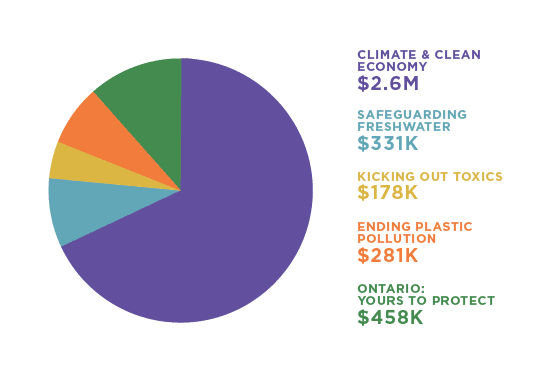
It takes all of our dedicated team working together to deliver the outcomes we’ve shared in this report. The program, engagement and communications staff along with our finance, development, and administration teams come together and deliver the change we have committed to our funders and supporters. For the full audited financial report, click here.
THANK YOU
A BIG THANKS to all of the individuals and organizations who generously supported our efforts between April 1, 2021 and March 31, 2022. Together, we accomplished more than we thought possible, and with your continued support, we know that we can accomplish even more in the year to come.